


Artist Engine v.1
- May 5
- 5 min read
Building the Artist Engine: A Responsible AI Workflow for Theatre Artist Relationships
I have been building a new kind of tool for theatre producing. It is called the Artist Engine, and it is designed to help literary managers, producers, and artist development teams manage relationships with artists more fairly, consistently, and effectively.
This post explains what I have built so far, how it connects to the Equity Engine for access and fairness work, and why I am taking a "responsible AI" approach to the technology.
The problem
Theatre companies meet hundreds of artists every year. They see shows, read scripts, attend festivals, and take meetings. But the systems for tracking these relationships are often messy. Information lives in spreadsheets, emails, notebooks, or individual staff members' memories.
This creates problems:
Artists get lost between submission and response.
Duplicate records appear when different staff members meet the same artist.
Access barriers go unnoticed until it is too late to help.
Equity patterns are invisible because the data is not structured.
Producers spend time on admin instead of relationship building.
The Artist Engine solution
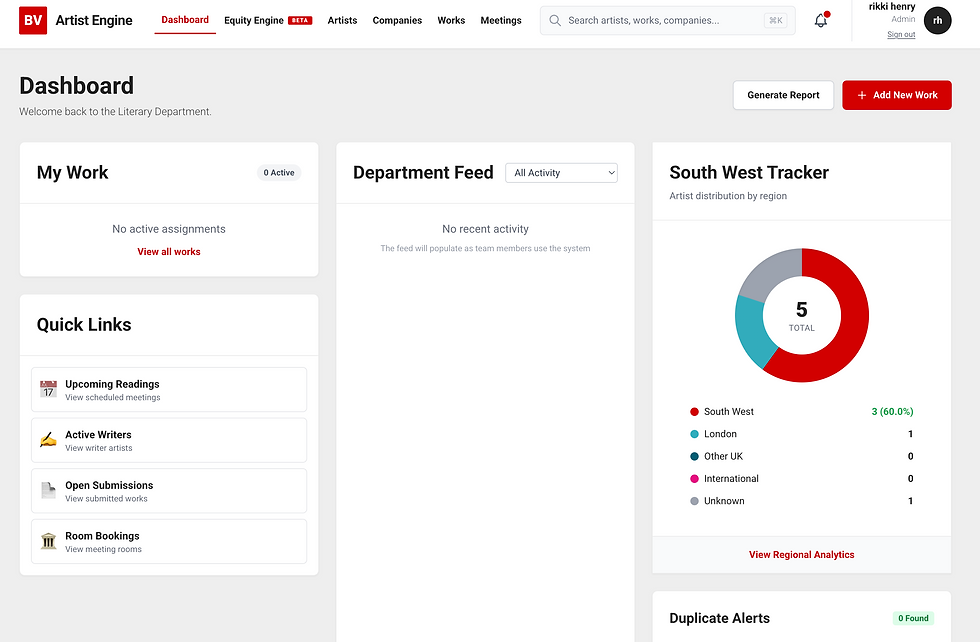
The Artist Engine is a workflow dashboard built on Next.js, Supabase, and TailwindCSS. It brings artist relationship management into one place.
Core records:
Artists – full profiles with contact details, location, South West status, artist type, tags, and notes.
Works – plays and projects linked to artists, with development stage, review status, and verdicts.
Meetings – scheduled interactions with artists, with outcomes and follow-up actions.
Companies – theatre companies, collectives, and production links.
Notes – observations after shows, events, or conversations.
The system is designed so that every interaction with an artist can be logged, searched, and connected to their overall relationship history. No more lost emails or forgotten conversations.
The Equity Engine layer
Where the Artist Engine collects data, the Equity Engine reflects on it.
The Equity Engine is a campaign and access dashboard that sits alongside the Artist Engine. It reads the relationship data and looks for patterns:
Who enters the pipeline and from which regions?
Where do artists drop out and why?
What access barriers appear most often?
Which artists need finance access support?
The Equity Engine includes a Finance Access Rider workflow. This is based on real-world equity work with RTYDS and the Fair Play campaign. It allows producers to:
Search for real artists in the database.
Check whether an artist has a completed rider.
Identify support needs like travel, childcare, or Universal Credit timing.
Create, send, and upload riders.
Log outcomes back to the artist profile.
Responsible AI, not replacement AI
I am building this as part of an AI practitioner's course, but the goal is not to automate artistic judgement. The goal is to use AI where it genuinely helps, while keeping human decision-making at the centre.
My principle: AI suggests, human reviews, system saves.
Here is how this plays out across the workflows:
1. Adding a new artist
When a producer discovers an artist, the system helps them check whether that artist already exists. AI can suggest possible duplicates based on similar names, emails, or company links. But the producer must confirm whether it is the same person. AI cannot create or merge records by itself.
2. Duplicate detection
AI reviews entered details and searches for similar existing artists. If the output is wrong—if AI misses a duplicate or suggests a false match—the consequence is duplicate records or confused identity. So the human must review every suggested match.
3. Profile improvement
AI can suggest missing fields, tags, or South West status based on the entered text. But the producer must accept, edit, or reject each suggestion. A wrong suggestion could misclassify an artist or create an inaccurate record.
4. The Finance Access Rider
AI could eventually help scan completed riders and extract support needs. But the decision to approve travel support, adjust payment timing, or provide childcare assistance must remain with the producing and finance teams. AI can prepare and summarise; humans must decide.
5. Equity pattern spotting
AI can flag patterns in the data—such as artists from a particular region dropping out before contract stage. But interpreting why that pattern exists, and what the organisation should do about it, requires human judgement and contextual knowledge.
Data flow between the engines
The relationship between the Artist Engine and Equity Engine is a loop:
Artist Engine collects – Artists, works, meetings, notes, and companies are created and linked.
Equity Engine reflects – The system reads this data and identifies equity patterns, barriers, and access needs.
Producer acts – A user selects an artist, reviews their rider status, and chooses an intervention.
Data writes back – Rider status, support outcomes, and follow-up actions are saved back to the artist profile.
Campaign evidence builds – Anonymised data points support RTYDS and Fair Play reporting, helping the organisation learn and improve.
This is not a one-way street. The Equity Engine is not a separate silo. It is a reflection layer that makes the Artist Engine data more actionable.
Current state and next steps
What is working now:
Artist profiles with full relationship history.
Work submissions with MAGIC review workflow.
Meeting and note logging.
Company and artist affiliation tracking.
Equity Engine dashboard with regional heatmap.
Finance Access Rider workflow with real artist search.
Database structure ready for rider records and access actions.
What is coming next:
Full database write-back for rider outcomes.
AI-assisted profile cleaning and duplicate detection.
Anonymised equity data reporting.
Spreadsheet import with AI-assisted cleaning.
Meeting brief generation with AI-suggested context.
Why this matters
Theatre is a relationship business. But relationships are hard to sustain at scale without good systems. The Artist Engine is designed to reduce the admin burden on producers while keeping them in control of artistic and ethical decisions.
The Equity Engine adds a crucial layer: it turns relationship data into equity insight. It helps organisations ask questions like:
Are we meeting artists from across our region, or just from the city centre?
Do artists with access needs drop out more often? If so, when?
Are we providing support early enough to make a difference?
What patterns should we report to funders, boards, and campaign partners?
These are not questions AI can answer alone. But AI can help humans notice the patterns faster, and make fairer decisions with better information.
A workflow example
Here is how the "Add new artist" workflow looks with responsible AI built in:
Step | AI or human? | What happens if AI is wrong? | Human review point? |
Discover artist | Human | N/A | Producer decides the artist should be considered. |
Collect information | Human | N/A | Producer checks details against the source. |
Search for duplicates | AI + Human | AI might miss a duplicate or suggest a false match. | Producer reviews suggested matches before continuing. |
Enter details | Human | N/A | Producer reviews the form. |
Validate fields | System + AI | AI might wrongly flag valid information or suggest incorrect status. | Producer reviews AI suggestions before saving. |
AI suggests improvements | AI | AI might suggest wrong tags, location, or type. | Producer accepts, edits, or rejects suggestions. |
Save artist | System | N/A | Producer confirms the record is correct. |
AI suggests next actions | AI | AI might suggest inappropriate follow-up. | Producer chooses whether to act on suggestions. |
Notice the pattern: AI assists at every step, but the human producer makes the final call.
Conclusion
The Artist Engine is not an AI product. It is a workflow system that creates the conditions for useful AI.
By structuring how artists, works, meetings, and notes are captured, it makes room for AI to help with summarisation, matching, flagging, and drafting—without ever replacing the human judgement that theatre producing requires.
The Equity Engine shows where this approach can lead: from relationship management to equity intervention, from data collection to fairer practice.
If you are building AI tools for creative or cultural organisations, I would encourage you to think in workflows, not just features. Ask where AI genuinely reduces burden, and where it risks removing essential human context. Design for review points, not automation.
AI should suggest. Humans should decide. Systems should remember.
That is the principle I am building towards.


Comments